
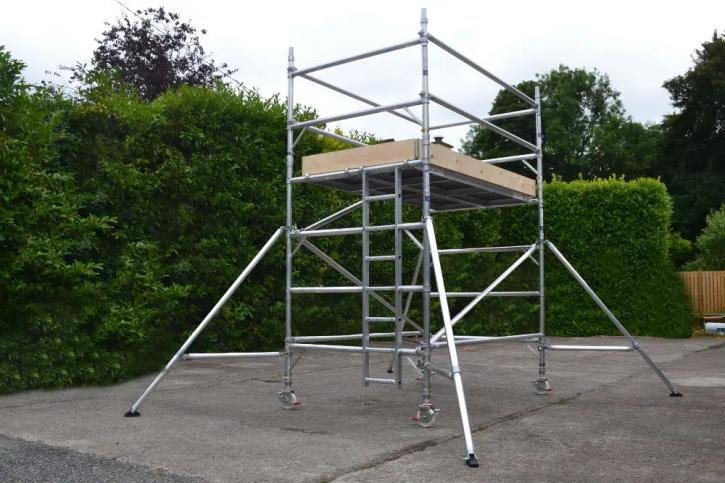
ALUMINIUM MOBILE SCAFFOLDING SYSTEM
Sharav Fab Aluminium Mobile Scaffolding Towers are lightweight, durable, and easy-to-assemble access solutions designed for safe working at height. Manufactured from high-quality aluminium, these towers offer excellent corrosion resistance, superior stability, and long service life. Ideal for maintenance, construction, warehousing, fabrication units, airports, commercial buildings, and industrial facilities, our scaffolding systems provide safe and efficient elevated access while ensuring maximum mobility and productivity.
KEY FEATURES
- Lightweight & Easy to Handle
Aluminium construction significantly reduces overall weight, enabling faster transportation, assembly, dismantling, and relocation while maintaining structural strength.
- Corrosion Resistant
Manufactured from premium-grade aluminium that naturally resists rust and corrosion, making it suitable for both indoor and outdoor applications.
- Quick Installation
Modular design and easy-lock components ensure quick setup and dismantling, reducing downtime and improving operational efficiency.
- High Strength & Stability
Engineered with robust frames, braces, stabilizers, guard rails, and locking caster wheels to provide excellent stability and user safety at elevated heights.
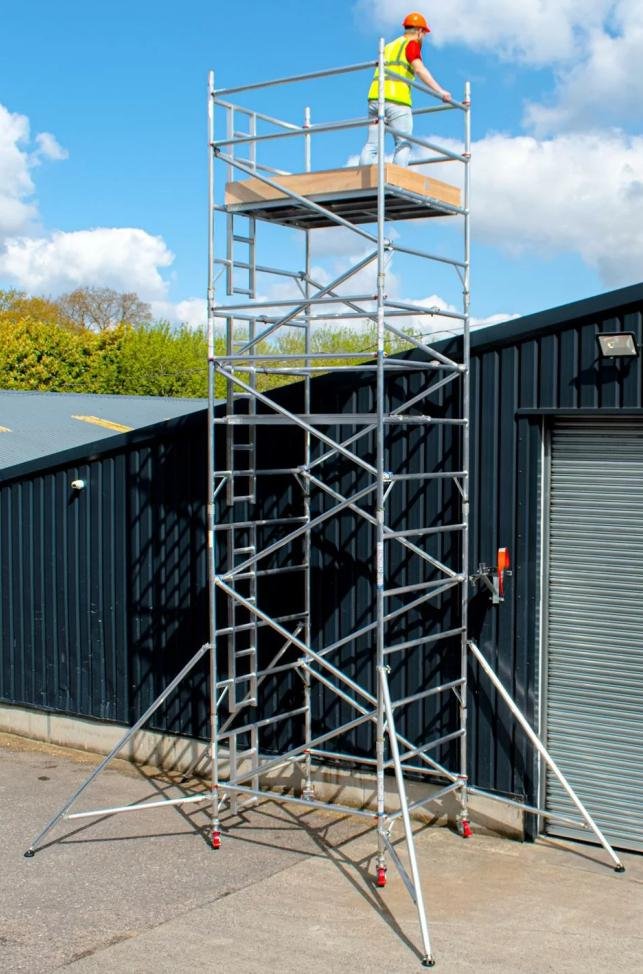
Sharav Fab – Complete Aluminium Scaffolding product page
Sharav Fab — Aluminium Access Solutions
ALUMINIUM
SCAFFOLDING
B-MASS Mobile Tower Systems
Lightweight, durable, and corrosion-resistant aluminium mobile scaffolding towers for construction, maintenance, industrial plants, warehouses, and infrastructure projects. Platform heights from 2M to 14M, width 1350mm.
Overview
What is an Aluminium Scaffold?
An aluminium scaffold is a lightweight, durable, and corrosion-resistant temporary access structure used for working at height in construction, maintenance, industrial plants, warehouses, fabrication units, and infrastructure projects. Compared to traditional steel scaffolding, aluminium scaffolds offer easier handling, faster assembly, and improved mobility.
Mobile aluminium towers are used throughout the building and construction industry for both indoor and outdoor access solutions where a stable and secure platform is required. Ideal for maintenance and installation work or short-term access, the highly versatile towers provide a strong working platform for a variety of heights.
Why Choose Sharav Fab
Key Benefits of Aluminium Scaffolding
Aluminium is significantly lighter than steel, making transportation, assembly, dismantling, and relocation faster and more efficient.
Aluminium naturally resists rust and corrosion, making it ideal for both indoor and outdoor industrial applications.
Modular design and easy-lock systems reduce setup time and improve productivity on-site.
Despite being lightweight, aluminium scaffolds provide excellent load-bearing capacity and structural stability.
Reduced labour time, low maintenance requirements, and long service life help lower operational costs.
Available with caster wheels and modular components for easy movement and adaptability across multiple applications.
Designed with anti-slip platforms, guard rails, and secure locking systems to ensure worker safety at all heights.
Sharav Fab aluminium scaffolding systems are designed and manufactured in accordance with OSHA Standards and recognised industrial safety and quality standards. High-quality aluminium alloy with precision welding and quality inspection for enhanced safety performance.
B-MASS STAIR-D (Double Width)
Component Diagram
The B-MASS STAIR-D Double Width tower system consists of the following key components, each engineered for structural integrity and safe operation at height.
Technical Specs
Stairway Tower Specifications
Frame Types Available
| Plain Frame | Rungs | Height (mm) | Weight (Kg) |
|---|---|---|---|
| Type 1 | 2 Rung-Guard | 900 | 4.000 |
| Type 2 | 3 Rung | 1200 | 6.400 |
| Type 3 | 4 Rung | 1600 | 8.560 |
| Type 4 | 5 Rung | 2000 | 10.700 |
Quantity Schedule
Components by Platform Height
| Component | Wt(Kg) | 2M | 4M | 6M | 8M | 10M | 12M | 14M |
|---|---|---|---|---|---|---|---|---|
| Plain Frame-5rungs | 10.7 | 1 | 3 | 5 | 7 | 9 | 11 | 13 |
| Entry Frame-5rungs | 10.5 | 1 | 1 | 1 | 1 | 1 | 1 | 1 |
| Plain Frame-GuardRail | 4.2 | 2 | 2 | 2 | 2 | 2 | 2 | 2 |
| Handrail with Lock | 3.2 | 1 | 2 | 3 | 4 | 5 | 6 | 7 |
| Platform 580×1775mm | 7.3 | 1 | 1 | 1 | 1 | 1 | 1 | 1 |
| 12mm Toe Board | — | 1 | 1 | 1 | 1 | 1 | 1 | 1 |
| Horizontal Brace | 2.5 | 6 | 8 | 10 | 12 | 12 | 14 | 16 |
| Landing Platform | 7.0 | — | 1 | 2 | 3 | 4 | 5 | 6 |
| Diagonal Brace | 2.7 | 2 | 4 | 6 | 9 | 11 | 14 | 16 |
| Check Sheet Platform-Trap Door | 7.7 | 1 | 1 | 1 | 1 | 1 | 1 | 1 |
| Castor Wheel 8×2 | — | 4 | 4 | 4 | 4 | 4 | 4 | 4 |
| Inter Lock Safety Clip | 3 | 8 | 12 | 16 | 20 | 24 | 28 | 32 |
| Stairway | 12 | 1 | 2 | 3 | 4 | 5 | 6 | 7 |
| Out Trigger | 18 | + | — | 4 | 4 | 4 | 4 | 4 |
| Total Self Weight (Kg) | — | 101 | 175 | 310 | 375 | 435 | 499 | 662 |
Note: A working level is a platform with Toe Boards & Double Guardrails. Max load on a platform is 225 Kg, evenly distributed. Maximum working levels per tower: 2.
Stairway Dimensions
| Type | Width (mm) | Length (mm) |
|---|---|---|
| Stairway — 7 Step | 400 | 2435 |
| Stairway — 3 Step | 350 | 1270 |
Step-by-Step
Assembly Procedure
Put Castor Wheels onto the Entry Frame along with the Plain Frame with the lock in the proper position to make it feasible to fix the brace. Ensure all wheels are securely fitted.
Fix one horizontal brace onto the vertical Plain Frame and lock the other end with the Entry Frame, just above the bottom rung, to make the frame self-supporting. Ensure the Brace Lock is fixed properly.
Put the diagonal brace on the bottom rung of the entry frame. Fix the other side to the third rung of the Plain Frame. Add another diagonal brace on the opposite side to make the tower stable.
Attach the stairway ladder inside on the top rung of the Plain Frame and put the other part of the stairway hook on the bottom rung of the entry frame. Hooks must be fixed evenly. Lock the handrail onto the side of the stairway on the frames for climb support.
Fix the Landing Platform on top of the frame. To extend the height, place the rung frame on top of the base frame. Ensure bottom collar is locked on the pin.
For safety support, lock the out trigger on all 4 sides of the tower. Ensure out trigger feet are equally spaced to form a square. Out trigger must always be fully extended. Required for platform heights 4.0M and above.
Put the fixed platform along with the access open-door platform on the frame at the required working height. Place Toe Boards on all sides of the platform to prevent tools from falling.
Place the Guardrail on top of the frames along with the horizontal brace to ensure a safety-free task. Complete tower is fixed and ready to use with high safety at the required reachable height.
Assembly Principle: To comply with work at height regulations, assembly procedures show platform at every 2 Mtrs in height, with the guardrail located in advance of climbing onto a platform to reduce risk. All platforms feature double guardrails on both faces. All guardrails should be 1 & 2 rungs (0.5 & 1.0m above platforms). Never stand on an unguarded platform.
Takedown Procedure
Dismantling Principle
- 1Remove toe board and pass down the scaffolding.
- 2Unclip farthest end of braces and immediately go to the protected trap door positions on the ladder to complete removal.
- 3Remove upper platforms from protected platform levels below.
- 4Pass removed components out of the scaffolding to a colleague.
Mobilising the Tower
Moving Instructions
- Move towers with caution. Check route for obstructions at ground level and overhead.
- Remove all people and materials. Reduce tower height to 4.0M before moving.
- Out Trigger should remain in position, raised no more than 25mm from the ground.
- Apply manual effort at or near the base of the tower only. Ensure sufficient operatives to control movement.
- After moving, check tower is still upright, complete, and level using a spirit level. Adjust legs as required.
- Do not move in wind speeds over 17 mph. Ensure no wires or iron threads pass overhead while moving.
Environmental Hazards
Wind Load on the Scaffold
In high wind conditions, wind is one of the most dangerous factors. In wind speeds over 25 km/h, cease all work on the scaffold.
If wind is expected to reach 32 km/h, tie the scaffold to a rigid structure.
If wind is likely to reach over 45 km/h, the scaffold must be dismantled. Beware of open-ended buildings that can cause a funnelling effect.
Wind imposes a horizontal load tending to overturn the scaffold. This is counteracted by self-weight and the stabilising effect of outriggers. Do not erect or use in winds exceeding 25 km/h.
| Force | Description | Speed (KPH) | General Effect |
|---|---|---|---|
| 4 | Moderate | 20–29 | Small branches move. Dust, leaves & paper raised |
| 5 | Fresh Breeze | 30–39 | Small trees sway |
| 6 | Strong Breeze | 40–49 | Small branches move. Telephone wires whistle |
| 7 | Moderate Gale | 50–59 | Large trees sway. Walking becomes difficult |
| 8 | Gale Force | 60–69 | Twigs & small branches broken. Walking is difficult |
Handling & Maintenance
Maintenance — Storage — Transport
All components and their parts should be regularly inspected to identify damage, particularly to joints. Lost or broken parts should be replaced. Any tubing with indentation greater than 5mm should not be used and should be set aside for repair by the manufacturer.
Adjustable leg threads should be cleaned and lightly lubricated to keep them free running. Brace claws, frame interlock clips, trap door latches, claw mechanisms and platform wind locks should be regularly checked to ensure they lock correctly.
Components should be stored in clean, dry conditions with due care to prevent damage. Ensure components are not damaged by excessive strapping forces when transported.
Ensure components are secured properly during transport. Avoid excessive strapping forces. Never allow components to be exposed to conditions that could cause corrosion or physical damage during handling.
Remember
Stability Essentials
Make sure the tower is resting on firm, level ground with locked castors or base plates properly supported.
Never use bricks or building blocks to take the weight of any parts of the tower.
Always check the safe working height by referring to the instruction manual before erecting the tower.
Towers should never be erected to heights above those recommended by the manufacturer.
Safety First
Safety Features & Best Practices
- Use only on firm and level surfaces
- Ensure all locking pins, braces, and guard rails are securely fixed before use
- Do not exceed the recommended 225 Kg load capacity
- Inspect scaffold components regularly for damage or wear
- Use proper access ladders and fall protection equipment
- Wheels/casters must be locked during operation
- Assembly and dismantling by trained personnel only
- Maintain safe distance from electrical lines and hazardous areas
- Never mix components from different manufacturers
- Tower has a single working level — safe working load is 225 Kg
- Do not use ladders, steps, or boxes to gain additional working height
- Mobile Access Towers are not designed to be lifted or suspended
Pre-Use Checklist
Safety Checklist
Refer to this checklist before each use. Tie in towers of all heights wherever possible.
For platform heights 4.0M and above — Out Trigger must be used. For platform heights 6.0M and above — Out Trigger is mandatory. Max load on any platform is 225 Kg, evenly distributed across the full platform level.
Loading
Loading Precautions
Working Platforms & Platform Loading
- The tower has a single working level with a safe working load of 225 Kg.
- All platforms may be used for working with the capacity of two people at a time, but one person is highly recommended for safety.
- The maximum safe working load (combined weight of users, tools and materials) that may be placed on a platform is 225 Kg, evenly distributed over the whole platform level.
- Toe boards must be added if any levels are used as a working platform or for storage of materials, per Work at Height Regulations.
Out Trigger Instructions
- Out Trigger shall always be fitted when specified. To improve stability, larger Out Trigger can be used at lower levels.
- Attach one out trigger to each corner of the tower. Ensure out trigger feet are equally spaced to form a square.
- Out trigger must always be fully extended for maximum safety. Position lower clamp so lower arm is as close to horizontal as possible.
- When moving, adjust top clamps or telescopic leg to lift four out trigger feet a maximum of 25mm from the ground then unlock castor brakes. Reposition in firm contact after moving.
Applications
Where We're Used
At SHARAV FAB, we deliver high-quality aluminium scaffolding solutions engineered for safety, durability, and operational efficiency. Our products are manufactured with precision, ensuring reliable performance for industrial and commercial applications.
